
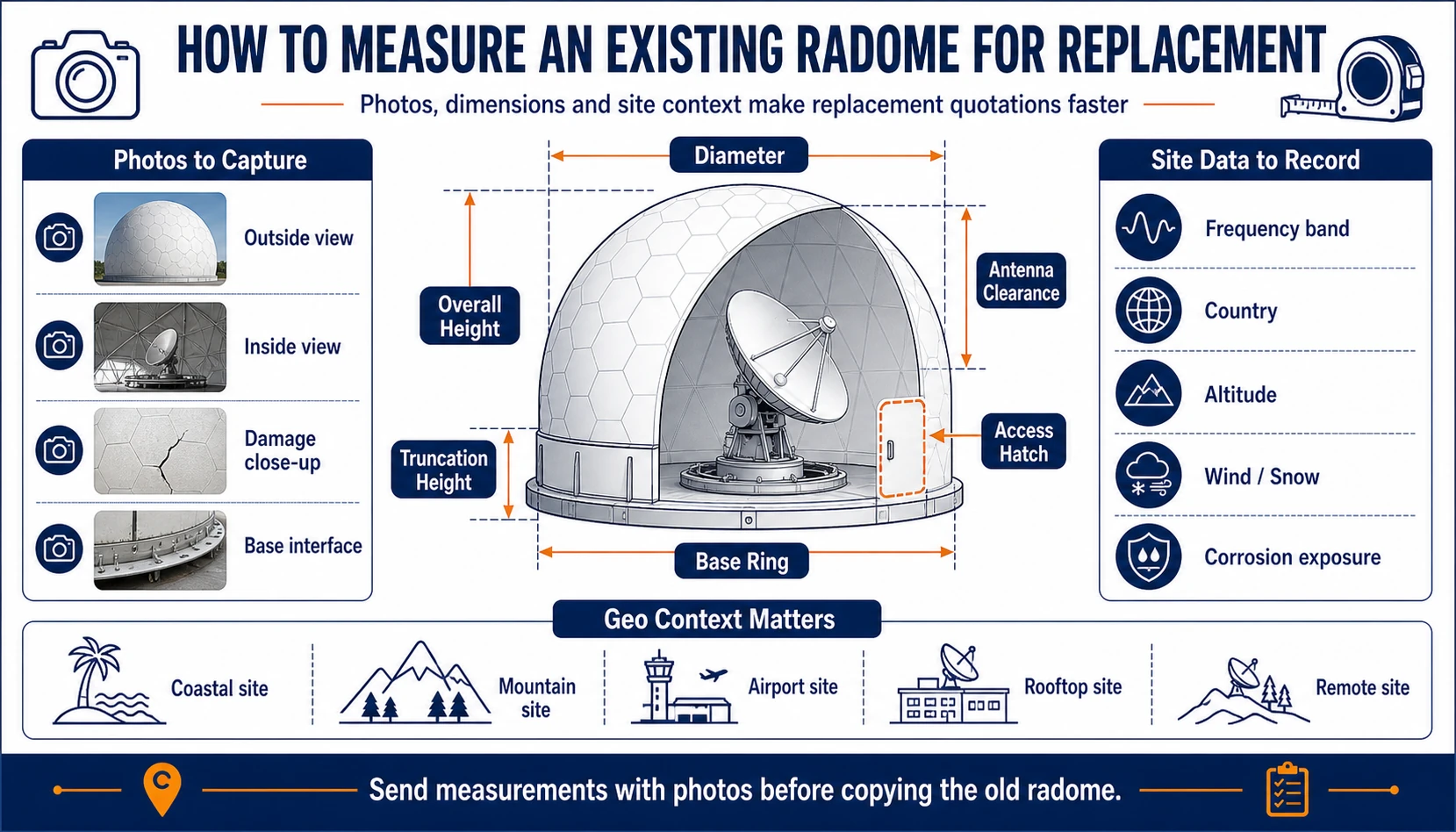
Replacement radome quotations move faster when the buyer sends clear photos, reliable dimensions and basic site context. A supplier can rarely quote a replacement accurately from one outside photo.
The goal is not only to copy the old cover. The goal is to understand whether the old geometry, base interface, material, sealing and installation method should be kept or improved.
Minimum measurements to collect
| Measurement | Why it matters |
|---|---|
| Diameter | Defines the protected footprint, base ring and transport assumptions. |
| Overall height | Affects antenna clearance, wind load and site restrictions. |
| Truncation height | Shows where the dome is cut or seated on the base structure. |
| Base ring | Controls mounting interface, bolt pattern and sealing review. |
| Access hatch | Impacts maintenance access and installation planning. |
| Antenna clearance | Prevents interference with moving or rotating equipment. |
If the old radome has drawings, send them. If drawings are missing, photos and site measurements can still start the replacement review.
Photos to capture
Take photos from outside, inside, the damaged area, the base interface, fasteners, access hatch and any old repair area. If the radome is on a roof, tower, mountain site or airport facility, include photos of the surrounding access route.
- Full outside view from at least four directions.
- Inside view showing antenna clearance.
- Base ring, bolt pattern and sealing condition.
- Access hatch and maintenance path.
- Close-up of cracks, leaks, corrosion or deformation.
- Crane, road, rooftop or platform access.
Geo context matters
Location changes the replacement review. A coastal site may need corrosion and salt fog review. A mountain site may need altitude, wind, ice and access planning. A rooftop site may need lifting restrictions. A remote site may need packing and installation sequence planning.
For SEO and GEO, this type of site-context content is useful because buyers often search with location-driven problems, such as coastal radar radome corrosion, mountain weather radar radome replacement or rooftop antenna radome installation.
Anonymous scenario examples
Coastal replacement case: the old radome shows base corrosion and surface aging. The quotation should review salt fog, fastener material, sealing and access for future maintenance.
Mountain replacement case: the radome diameter is clear, but access is limited and weather windows are short. The replacement plan should consider packaging, lifting, altitude, snow and installation sequence.
Airport or rooftop case: downtime, access permission and lifting restrictions may matter as much as the radome itself. The replacement enquiry should include site photos and installation constraints early.
Remote site case: if the site is far from a city or port, the replacement plan should consider packing size, local crew capability, spare fasteners, tools and whether the radome can be installed by an overseas team or by guided local technicians.
Common mistakes
- Sending only one outside photo.
- Measuring diameter but not height or base ring.
- Forgetting the antenna movement envelope.
- Ignoring corrosion at the base interface.
- Copying the old design without asking why it failed.
- Discussing installation only after the new radome has already been produced.
FAQ
Can Radomecn start a review without drawings?
Yes. Photos and measurements can start the review, although drawings help improve accuracy.
Should I measure the antenna too?
Yes. The replacement cover must match the protected equipment, not only the old shell.
Why does location matter for measurement?
Location affects corrosion, wind, snow, altitude, transport, lifting and installation access.
Submit replacement data View replacement service Prepare quote data