
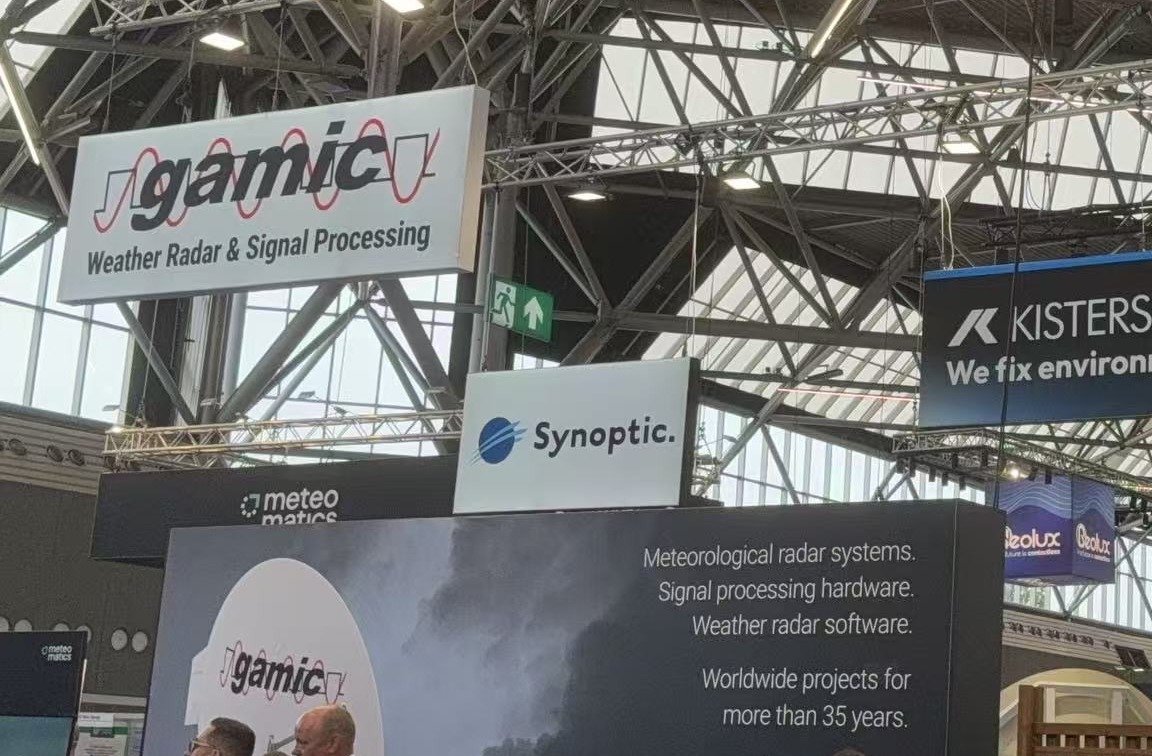
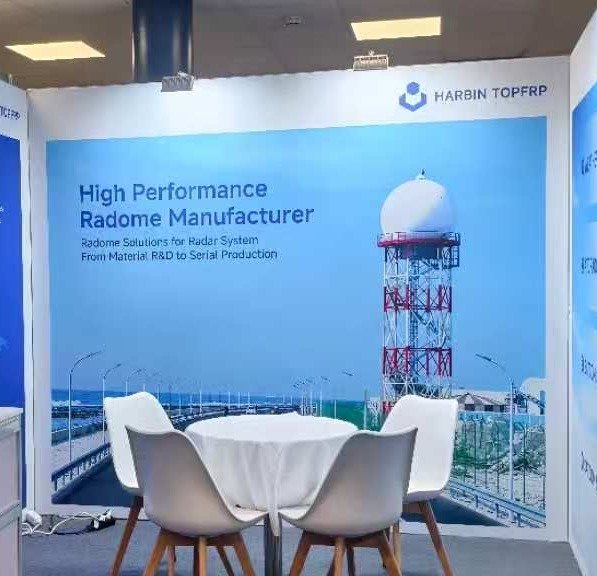
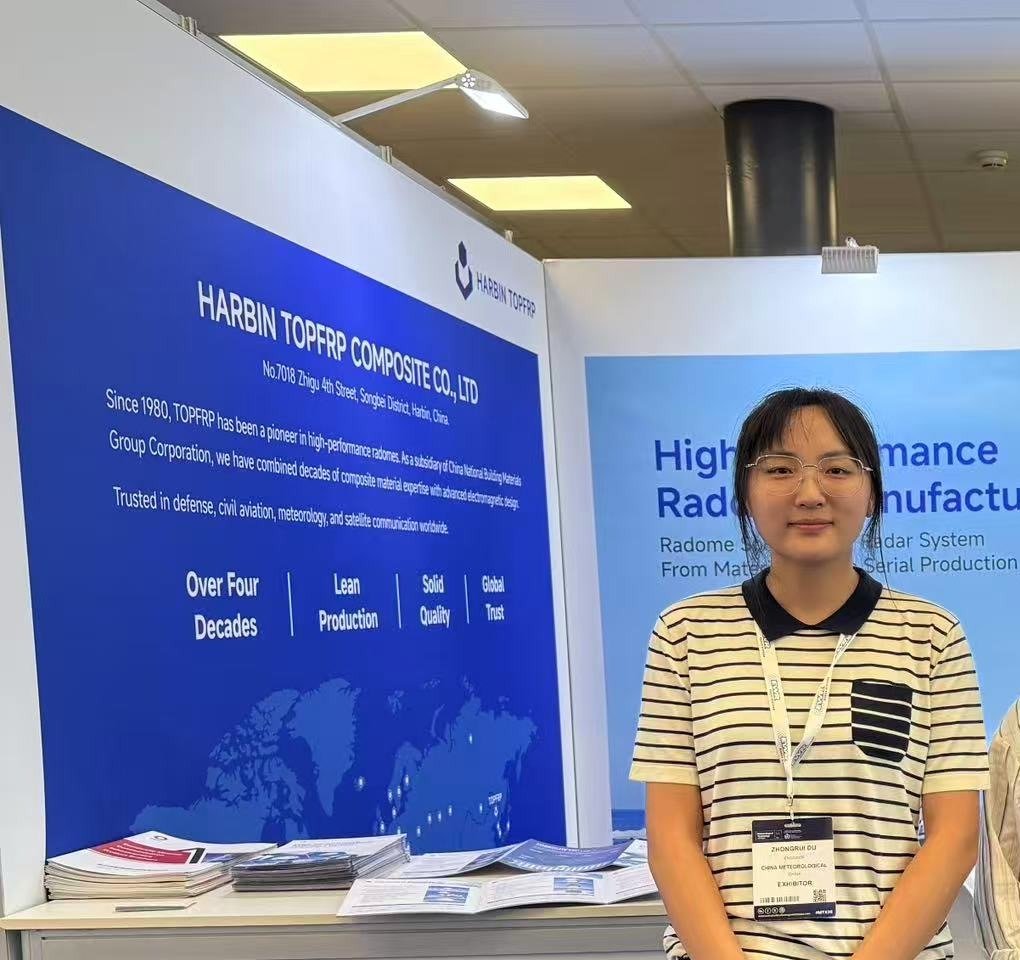
From 6 to 8 October 2026, Radome Focus joined Meteorological Technology World Expo 2026 at RAI Amsterdam. We were on stand F07 together with our manufacturing factory, Harbin TOPFRP, which has been building radomes since 1980 for weather radar, air traffic control and airport radar, and satellite communication ground stations.
Three days in the hall gave us direct conversations with radar builders, network operators, system integrators and meteorological services. This post records what we showed, what we heard, and what it means for radome selection over the next few years.
What we showed at stand F07
Our stand focused on one message: a high-performance radome is part of the radar system, not just a cover. We presented our radome families for civil weather radar and airport surveillance:
- Weather and satellite communication radomes for X, C and S band weather radar and ground station antennas.
- Air traffic control radomes for airport and en-route surveillance radar.
- FRP sandwich radomes and metal space frame radomes for larger antennas.
- Our RF and structural testing process and factory capability, from material development to serial production.
The trend: solid-state and phased-array weather radar
The clearest theme across the show was the move from traditional magnetron dish radars to solid-state transmitters and phased-array antennas. Several exhibitors presented flat-panel or multi-face arrays, and many visitors were planning upgrades of existing radar networks.
A second theme was distributed X-band networks: many smaller, lower-power radars placed close to cities, airports, valleys and coasts to fill gaps left by large long-range radars. These networks need a large number of identical sites that are fast to deploy and easy to maintain.
Why this matters for the radome
Both trends put more pressure on the radome:
- Lower power, less margin. Solid-state transmitters run at lower peak power than magnetrons, so every fraction of a decibel lost in the radome costs detection range. High transmissivity and low insertion loss become design targets, not nice-to-haves.
- Wide scan angles. A phased array steers its beam electronically, so the radome must perform well across a wide range of incidence angles, not only on boresight. Wall structure, panel joints and material consistency all matter.
- Wet-radome loss. Water film on the surface attenuates the signal in heavy rain, exactly when weather radar is most needed. Hydrophobic coatings and surface quality help keep data reliable.
- Repeatability at network scale. For distributed X-band networks, every radome should behave the same, ship efficiently and install quickly on site.
These are the points we discussed most at the stand, and they are where our work on materials, sandwich design and testing is focused. Our technical parameters guide explains transmission loss, boresight error and other key specifications, and the radome selection guide helps match radome type to radar band and site conditions.
Follow our exhibitions
We keep a running record of the trade shows we attend on our Exhibitions page, with photos and notes from each event. If you missed us in Amsterdam, or want to meet at a future show, let us know.
Talk to us about your radar project
Planning a solid-state upgrade, a phased-array radar or a new X-band network? Send us your antenna size, frequency band and site conditions and we will recommend a radome solution. You can also use our radome enquiry form.