
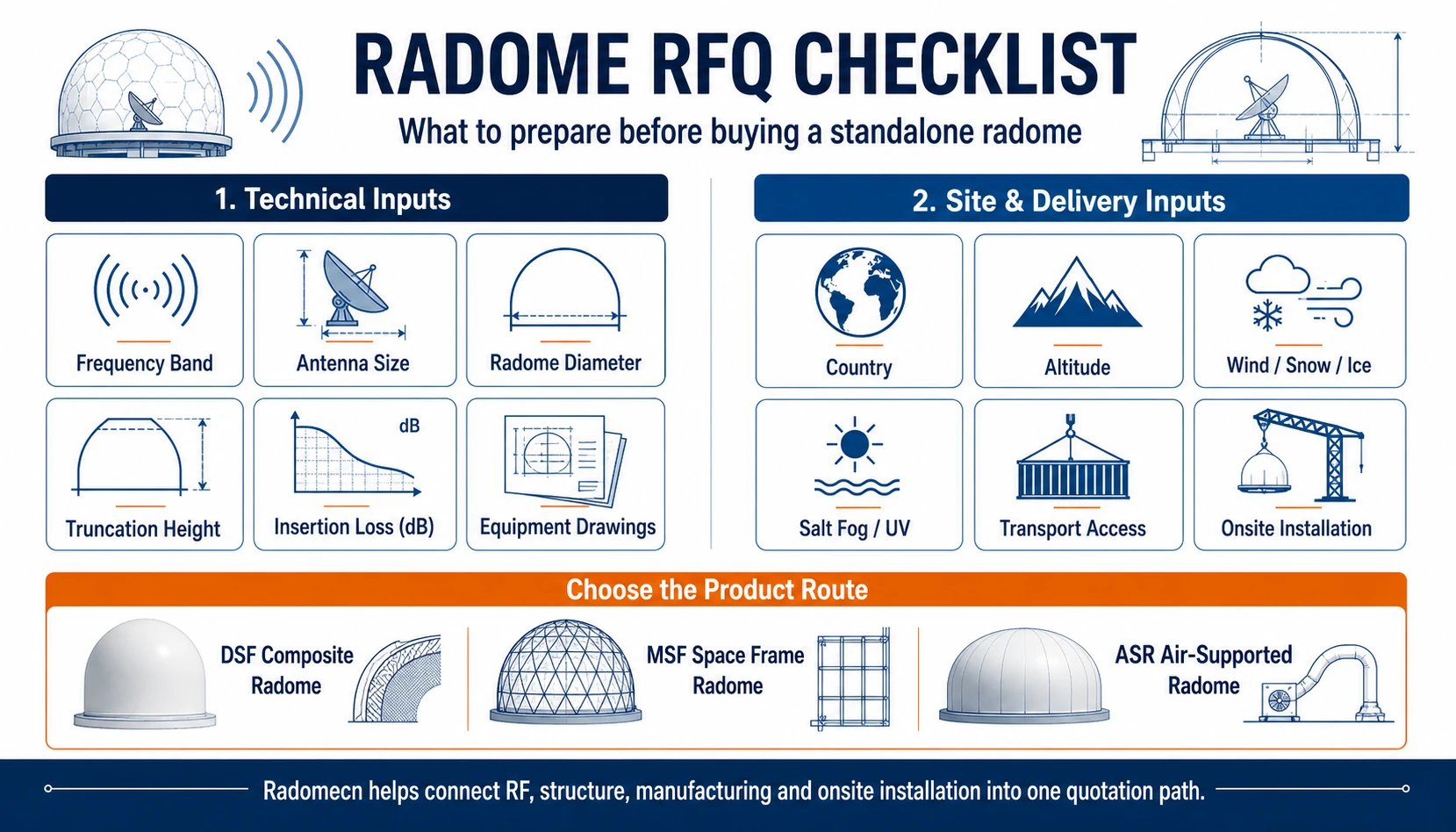
Most radome quotations are delayed for the same reason: the buyer asks for a price before the supplier understands the antenna, the RF band, the site environment or the installation conditions.
A radome is not only an outdoor cover. It must protect the antenna or radar while allowing the system to work within the required frequency range and performance limits. A useful quotation must answer three questions: will the radome fit the equipment, will it meet RF and environmental requirements, and can it be transported and installed safely at the project site?
Minimum data for a first radome review
| Information | Why it matters | Example input |
|---|---|---|
| Frequency band | Affects material, wall structure and RF review. | L / S / C / X / Ku / Ka band or exact operating range. |
| Antenna or radar size | Determines clearance and radome diameter. | Antenna diameter, height and rotation envelope. |
| Radome size | Defines shell, panel split, transport and installation. | Diameter, height and truncation height. |
| RF target | Helps review transparency and acceptable loss. | Insertion loss target in dB, if specified. |
| Site environment | Affects structure, material and service life. | Country, altitude, wind, snow, UV, salt fog. |
| Project type | Changes the quotation path. | New supply, replacement or onsite installation. |
1. Frequency band
The frequency band is one of the first items a radome manufacturer needs to know. L, S, C, X, Ku, Ka and other bands can lead to different material, thickness, wall structure or RF review requirements. If you know the exact operating range, send it. If you only know the antenna or radar model, send the equipment datasheet.
- Operating frequency band or range.
- Required transmission or transparency target.
- Maximum insertion loss in dB, if specified.
- Antenna polarization or scanning behavior, if relevant.
- Application: radar, satcom, weather radar, ATC or other communication use.
2. Antenna or radar size
The radome must fit the real equipment envelope, not only the nominal antenna diameter. A common mistake is to send only the antenna dish diameter. The quotation should also consider antenna height, moving range, internal clearance, maintenance access, base ring and platform dimensions.
3. Radome size and truncation height
Some customers already know the required radome diameter. Others only have antenna data and need the manufacturer to recommend a cover size. Diameter, overall height and truncation height are all important. Truncation height is easy to overlook, but it affects clearance, geometry, base interface and installation method.
4. Expected RF performance
If your project has a maximum insertion loss requirement, express it in dB and specify the frequency band. For technical projects, the manufacturer may also review transmission loss, reflection, beam distortion, depolarization, frequency selectivity or wet-surface effects.
5. Country, altitude and environment
Radomes are exposed structures. A cover that is suitable for a mild inland site may not be suitable for a coastal, high-altitude or heavy-snow location. Share the project country, altitude, wind speed, snow load, ice condition, temperature range, UV exposure, salt fog and corrosion environment before quotation.
6. Product type: DSF, MSF, ASR or custom
Radomes can be classified by structure and material. The right product route depends on size, frequency, environmental load, transport and installation method.
| Type | General structure | Typical project logic |
|---|---|---|
| DSF radome | Fiberglass material with foam core layer. | FRP/composite shell for antenna, radar and replacement projects. |
| MSF radome | Metal structure with RF-facing membrane. | Large-span sites where modular structure and onsite assembly matter. |
| ASR radome | Aramid fiber or PVC membrane supported by air pressure. | Large enclosed antenna sites using air control and hoisting installation. |
7. Installation and transport conditions
Installation is not only an after-sales issue. It affects design and quotation from the beginning. A radome may be shipped as an integrated cover, segmented panels, a modular frame structure or a membrane system. The quotation should consider container transport, lifting access, scaffolding, hoisting, air control setup and local installation responsibility.
8. New supply or replacement?
A new radome enquiry usually starts from the protected equipment and site conditions. A replacement enquiry starts from the old radome and the reason it failed. For replacement, send photos, old drawings, visible damage notes, existing diameter, height, base ring and whether the antenna or radar inside still operates normally.
Common mistakes that slow down a quote
- Asking for price with only a diameter and no frequency band.
- Sending antenna model but no site country or environmental load.
- Giving radome diameter but no height or base interface.
- Saying "low loss" without a target band or dB requirement.
- Treating installation as something to discuss after production.
- For replacement, sending only one photo and no dimensions.
Practical RFQ checklist
- Antenna, radar or communication equipment type.
- Frequency band or exact operating range.
- Antenna size, height and movement envelope.
- Required radome diameter, height and truncation height.
- Insertion loss target in dB if available.
- Site country, altitude and climate.
- Wind, snow, ice, UV, salt fog and temperature conditions.
- New supply, replacement or onsite installation scope.
- Foundation, base ring, platform, transport and lifting access.
- Photos, drawings or existing radome information.
FAQ
Can I get a quotation without knowing insertion loss?
Yes, for an initial discussion. But the supplier still needs frequency band and equipment type to know what RF review may be required.
Can you quote from photos only?
Photos help, especially for replacement, but dimensions, frequency band and site conditions are still needed before a reliable quotation.
Do I need to know whether I need DSF, MSF or ASR?
Not necessarily. If you provide size, frequency, environment and installation constraints, the manufacturer can recommend a suitable route.
Why does country matter?
Country helps define climate assumptions, logistics, standards, documentation and possible onsite installation planning.