
Satellite ground infrastructure is changing. Traditional GEO satellite networks are now being combined with MEO and LEO systems, and many operators are investing in multi-orbit ground segment capability, gateway stations, teleports, earth stations and remote antenna sites.
For Radome Focus, this market is not only about selling a protective cover. It is about understanding where a radome fits in the satellite ground station supply chain, who defines the specification, and when a standalone radome supplier should be involved.
The supply chain map
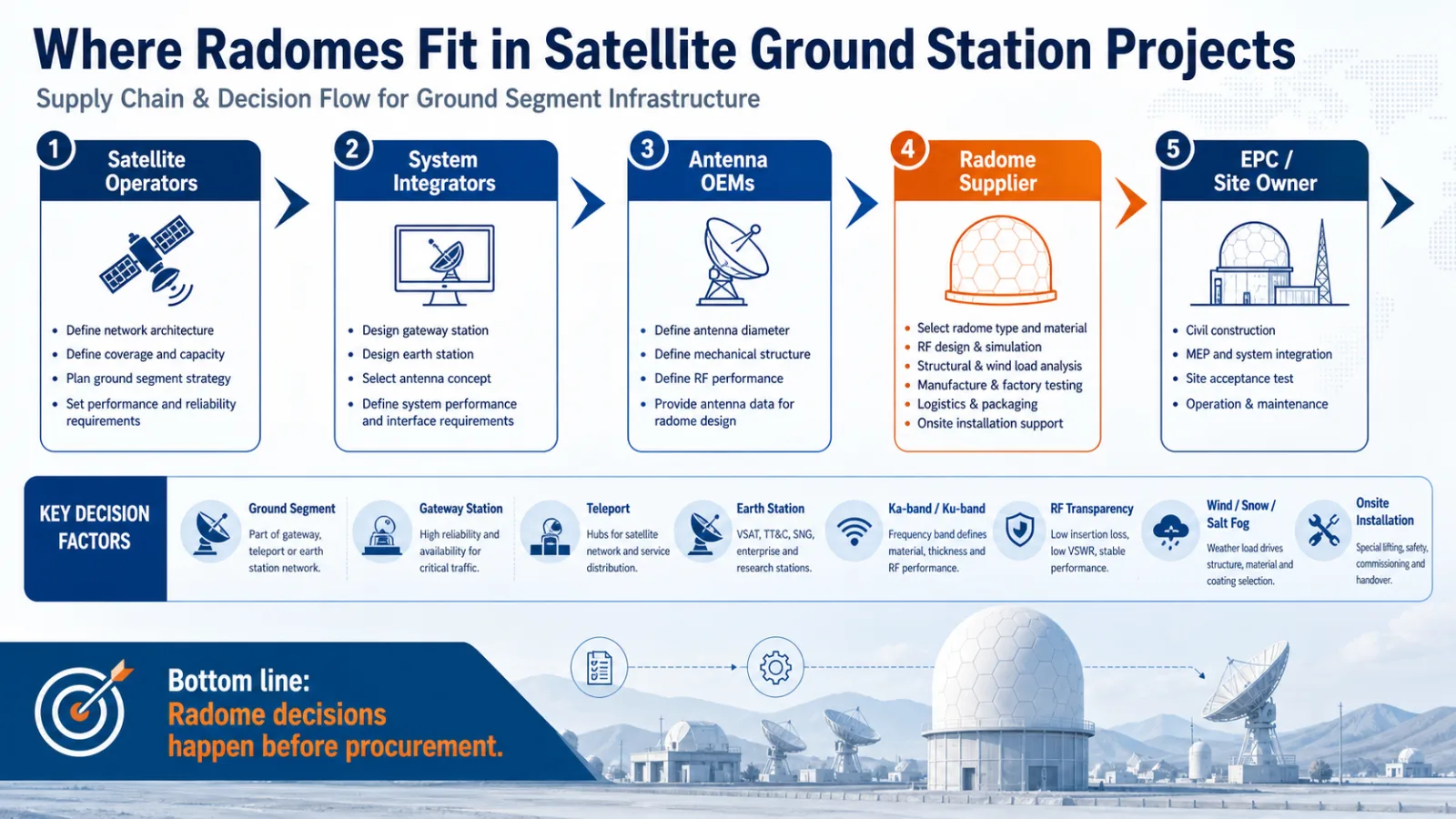
In many satellite ground station projects, the decision chain looks like this:
| Layer | Typical role | Radome relevance |
|---|---|---|
| Satellite operator | Defines network architecture, coverage, gateway need and service requirements. | May define uptime, site reliability, frequency band and operating environment. |
| System integrator | Designs the ground segment, gateway station or teleport architecture. | Often influences whether a radome is required and what constraints it must meet. |
| Antenna OEM | Defines antenna diameter, motion envelope, frequency band and equipment interface. | The radome must fit the antenna system, not only the site footprint. |
| Radome supplier | Provides RF-transparent environmental protection. | Reviews RF transparency, insertion loss, wind load, snow load, salt fog, material and installation method. |
| EPC / site owner | Builds or operates the site. | Needs practical delivery, installation access, maintenance planning and replacement support. |
The important point is simple: radome decisions often happen before procurement. By the time a purchasing department asks for a quotation, the project may already have a preferred radome type, antenna interface and environmental specification.
Why procurement is not the first door
Many manufacturers try to enter the satellite industry by contacting procurement first. That can work for repeat purchasing, but it is often too late for new gateway station projects.
The technical route is usually influenced earlier by ground segment directors, system architects, gateway station engineers, RF engineers, antenna engineers, infrastructure teams, system integrators and antenna OEMs.
These people can influence whether a project uses a fiberglass radome, composite radome, metal space frame radome, air-supported radome, modular radome or no radome at all.
Why satellite ground stations need radomes
A radome is not a decorative shell. For satellite communication infrastructure, it protects the antenna system while supporting stable RF performance and long-term site reliability.
- Coastal salt fog.
- High wind load.
- Snow load and ice load.
- UV aging.
- Desert dust and sand abrasion.
- Tropical humidity.
- Typhoon or hurricane wind.
- Temperature cycling.
- Remote site maintenance difficulty.
For gateway stations, teleports, earth stations and remote antenna sites, a radome can help protect uptime, reduce maintenance risk and extend the service life of the antenna system.
Key project keywords Radome Focus tracks
Industry entry keywords
Satellite ground station, gateway station, earth station, teleport, ground segment, ground infrastructure, satellite gateway, LEO gateway, MEO gateway, GEO ground station, multi-orbit network, 5G NTN ground infrastructure, satellite communication infrastructure and teleport antenna protection.
Customer scenario keywords
Island communication, remote connectivity, Africa gateway station, maritime satellite communication, mining communication, oil and gas communication, coastal satcom site, remote antenna site, high altitude ground station, harsh environment antenna protection, tropical satellite ground station and desert satellite communication site.
Radome product keywords
Satellite antenna radome, gateway station radome, earth station radome, teleport radome, satcom radome, Ka-band radome, Ku-band radome, composite radome, fiberglass radome, FRP radome, modular radome, metal space frame radome, air supported radome, inflatable radome, antenna weather protection and RF transparent enclosure.
Technical decision keywords
RF transparency, insertion loss, transmission loss, return loss, boresight error, cross polarization, frequency band, Ka-band, Ku-band, Q/V-band, antenna diameter, antenna movement envelope, truncation height, wind load, snow load, ice load, salt fog resistance, UV resistance, structural simulation, RF testing and onsite installation.
Where Radome Focus fits
Radome Focus should be involved when the project team needs a standalone radome source rather than a complete antenna package.
- The antenna package does not include a suitable environmental enclosure.
- The site is coastal, island-based, tropical, high-altitude, desert, cold-region or remote.
- The project needs a modular radome or onsite installation route.
- An existing antenna still works, but the old radome is aging, leaking, cracked or no longer reliable.
- The project team needs to compare FRP, metal space frame and air-supported radome routes.
- The specification needs RF transparency, insertion loss, wind load, snow load, salt fog and installation review.
Radome Focus provides factory-backed radome supply, replacement and onsite installation support for satellite ground stations, gateway stations, teleports and remote antenna sites.
Questions to ask at a satellite industry event
- Who specifies radomes in your gateway station projects?
- At what stage is the radome supplier selected?
- Do you use standalone radome suppliers or antenna OEM bundled solutions?
- Which frequency bands are most common in upcoming projects: Ku, Ka or Q/V?
- Are modular radome systems accepted for European or African projects?
- What are the main site risks: wind, snow, salt fog, heat, dust or humidity?
- Do you have upcoming gateway, teleport, island or Africa connectivity projects?
- Who currently supplies your radomes?
- Do you need supply only, replacement or onsite installation support?
Summary
Radome Focus's opportunity is not to wait for a late-stage procurement request. The better path is to be known earlier by the people who define the satellite ground station specification: system architects, ground segment teams, antenna engineers, system integrators and site infrastructure teams.
When a project needs a satellite antenna radome, gateway station radome, teleport radome, modular radome, air-supported radome, replacement radome or onsite installation support, Radome Focus should be visible as a factory-backed option.
Send satellite ground station data Use radome selection guide View satcom radomes