
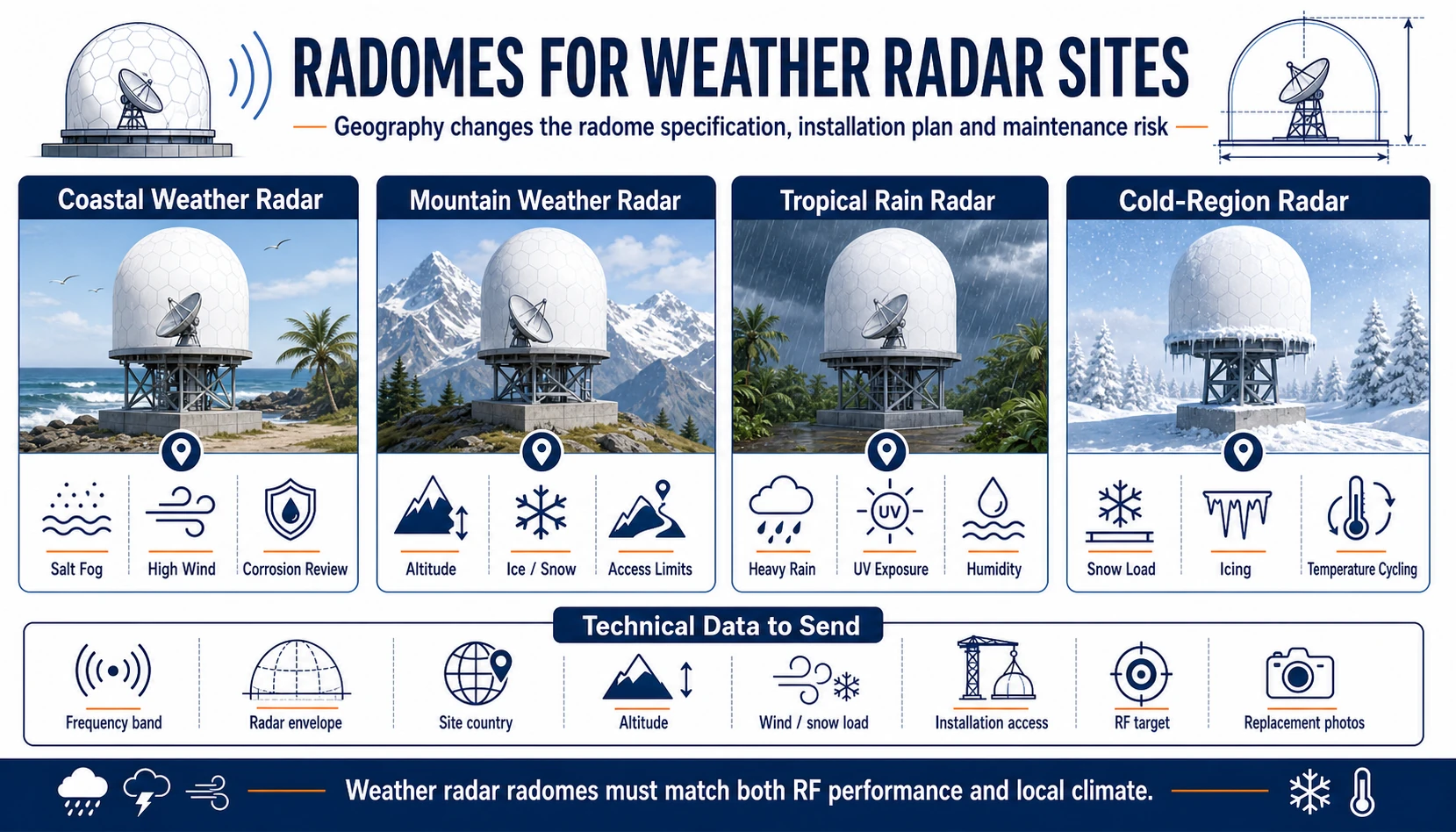
Weather radar radomes are not specified by diameter alone. Geography changes the radome specification, installation plan and maintenance risk.
A coastal radar site, mountain radar site, tropical rain radar site, desert radar site and cold-region radar site may all protect similar equipment, but they do not create the same technical questions.
Weather and geography scenario matrix
| Site scenario | Main radome concerns | What buyers should prepare |
|---|---|---|
| Coastal weather radar | Salt fog, high wind, corrosion, fastener and base interface reliability. | Country, distance from coast, corrosion exposure, wind load, access photos. |
| Island or offshore-adjacent site | Strong wind, salt spray, logistics limits, limited repair window and difficult lifting access. | Marine exposure, port distance, available crane, transport route and maintenance plan. |
| Mountain weather radar | Altitude, ice, snow, strong wind, logistics and limited installation windows. | Altitude, snow/ice data, road access, lifting plan, installation season. |
| Tropical rain radar | Heavy rain, humidity, UV exposure, wet-surface RF performance and sealing. | Rainfall exposure, UV, temperature, humidity and maintenance access. |
| Desert or dusty site | Sand, dust abrasion, UV, high daytime temperature and large day-night temperature swing. | Dust exposure, temperature range, cleaning method, wind-blown sand condition. |
| Typhoon or hurricane wind area | Extreme wind load, rain impact, fastener reliability, base anchoring and emergency maintenance. | Design wind speed, gust data, local code, foundation information and shutdown limits. |
| Cold-region radar | Snow load, icing, temperature cycling, material behavior and maintenance safety. | Temperature range, snow load, icing condition, site access in winter. |
| Urban rooftop or airport site | Downtime, access permission, lifting restriction, safety control and work window. | Roof load limit, crane access, working hours, permit requirements and site photos. |
| Remote inland site | Long transport route, limited skilled labor, spare parts planning and field assembly risk. | Nearest port/city, road condition, local crew ability, tool availability and packing limits. |
Coastal weather radar case analysis
For coastal sites, corrosion review should start early. Salt fog can affect fasteners, metal interfaces, base rings and maintenance access. The radome structure should be reviewed together with sealing and installation details.
Useful enquiry details include site country, distance from coastline, wind requirement, corrosion expectation, base interface photos and whether stainless fasteners or special surface protection are needed.
Island and offshore-adjacent site analysis
Island and near-offshore sites often combine salt spray, strong wind and difficult logistics. Even when the radome is small, replacement cost can rise if access, lifting and spare parts are not planned early. Buyers should send port distance, crane availability and preferred maintenance window.
Mountain weather radar case analysis
Mountain sites often combine altitude, wind, snow, ice and difficult logistics. A quotation should not only cover radome material; it should also review packaging, transport route, crane access, weather window and onsite installation responsibilities.
Altitude and access can change the installation method. If the site road is narrow or seasonal, the radome supplier should know before deciding panel size, packing and assembly sequence.
Tropical rain radar case analysis
Tropical sites may face heavy rain, humidity and UV exposure. Buyers should discuss wet-surface RF concerns, waterproof sealing, surface aging and maintenance frequency.
The question is not only whether the radome can resist rain. The more useful question is how the radome performs after long-term exposure to heat, humidity, UV and repeated wet/dry cycles.
Desert and dusty site analysis
Desert sites may face dust, sand abrasion, strong sunlight, high daytime temperature and large day-night temperature swings. A useful specification should cover surface durability, cleaning access, sealing, thermal movement and whether wind-blown sand is a regular condition.
Typhoon or hurricane wind area analysis
For typhoon, cyclone or hurricane-prone areas, design wind speed and gust data should be provided before quotation. The radome review should include panel structure, fasteners, base anchoring, sealing and how the site can be inspected after extreme weather.
Cold-region radar case analysis
Cold-region sites require attention to snow load, icing, temperature cycling and safe maintenance access. The radome may need structural and material review beyond basic RF transparency.
For replacement projects, old photos showing snow accumulation, ice marks or panel deformation can help the supplier understand the site history.
Urban rooftop, airport and remote site analysis
Some projects are not difficult because of climate alone. They are difficult because of access. Rooftop, airport and remote inland sites may require special work permits, restricted working hours, crane planning, compact packaging or guided installation with local crews.
Technical data to send
- Frequency band and radar type.
- Radar envelope, antenna movement and required clearance.
- Site country, altitude and climate description.
- Wind, gust, snow, ice, UV, rainfall, humidity, salt fog, dust and temperature requirements.
- Target insertion loss or RF performance requirement if available.
- Transport, lifting and installation access.
- Replacement photos if an old radome exists.
SEO and GEO note for project content
For future project case pages, Radomecn should describe the site by geography and environment rather than only product type. A useful case title could be "Coastal weather radar radome replacement in West Africa" or "High-altitude weather radar radome review for mountain site," as long as the location and project details are accurate and approved for publication.
This helps search engines and AI systems connect Radomecn with real buyer problems: corrosion, altitude, snow load, heavy rain, dust, typhoon wind, installation access, downtime and RF performance.
FAQ
Is a weather radar radome different from a normal antenna cover?
It can be. Weather radar sites often need careful RF, weather and site reliability review.
Can one weather radar radome design fit every geography?
No. Geography affects corrosion, wind, rain, dust, snow, icing, UV, installation and maintenance risk.
Should site photos be sent before quotation?
Yes. Site photos help the supplier understand access, base interface, replacement condition and installation constraints.
Send weather radar data View weather radar radomes View RF testing