
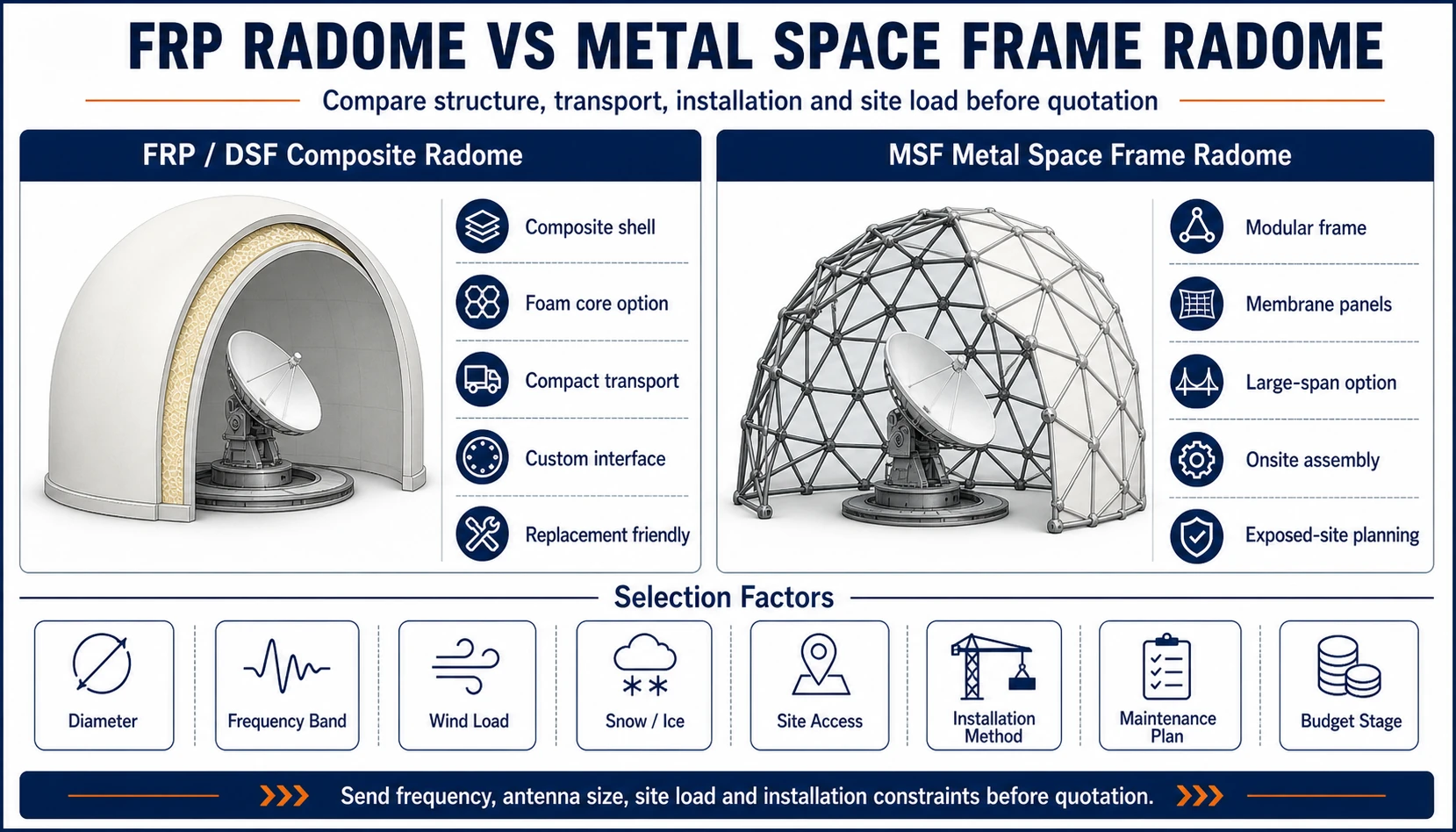
FRP radomes and metal space frame radomes can both protect antenna, radar and communication equipment. But they are not interchangeable products.
The right choice depends on protected equipment size, frequency band, site load, transport route, installation method and long-term maintenance plan. A buyer who selects only by diameter may choose a structure that looks correct but creates problems during RF review, shipping or site installation.
Quick comparison
| Decision point | FRP / DSF composite radome | MSF metal space frame radome |
|---|---|---|
| Structure | Composite shell, often with sandwich or foam core options. | Metal frame with RF-facing membrane or panel system. |
| Project logic | Compact cover, custom interface, replacement-friendly geometry. | Modular structure, large-span option, onsite assembly planning. |
| Transport | Often easier for small and medium covers, depending on size. | Usually planned as modular parts, frame sections and panels. |
| Installation | Lifting, sealing and base interface checks are central. | Assembly sequence, frame alignment and panel or membrane installation matter. |
| RF review | Depends on material, wall structure, band and target loss. | Depends on frame geometry, membrane/panel material and antenna envelope. |
What is an FRP / DSF composite radome?
An FRP radome is a fiberglass reinforced plastic or composite radome. The 2024 RadomeFocus brochure describes DSF radomes as fiberglass material with a foam core layer. This route is often considered when the project needs a rigid composite cover with a defined shape, weather resistance and a custom base interface.
What is a metal space frame radome?
A metal space frame radome uses a structural frame with RF-facing panels or membrane. This route is often considered when the protected volume becomes larger, when transport must be modular, or when a rigid shell becomes difficult to manufacture or ship as one cover.
RF review: do not choose by structure alone
Both FRP and MSF radomes need RF review. A radome should protect the equipment without creating unacceptable signal loss, reflection, beam distortion or other RF issues. Frequency band, insertion loss target, antenna movement envelope, wet surface and ice conditions should be discussed early.
Site load and environment
The site environment often decides which route is more realistic. Coastal sites may require corrosion and salt fog review. Mountain or high-altitude sites may require wind, snow, ice, UV and access review. Civil radar sites may require documentation, reliability and downtime planning.
Transport and installation
Transport and installation are not secondary details. FRP radomes may be easier to manage when the size is compact enough for shipping and lifting. Metal space frame radomes are often more modular, but onsite assembly requires planning, skilled labor and sequence control.
Common selection mistakes
- Choosing FRP only because it looks simpler.
- Choosing MSF only because the project is large, without checking installation access.
- Comparing price before defining frequency band and site load.
- Ignoring replacement history and copying an old failure.
- Treating transport and installation as post-quotation details.
Buyer checklist
- Equipment model and frequency band.
- Antenna size, height and rotation envelope.
- Required radome diameter, height and truncation height.
- Wind, snow, ice, UV and corrosion requirements.
- Insertion loss target if available.
- Site access, transport and lifting conditions.
- Replacement photos and drawings if applicable.
FAQ
Is FRP always cheaper than metal space frame?
Not necessarily. Final cost depends on size, material, structure, transport, installation and project requirements.
Is MSF only for very large radomes?
It is often used for larger or more modular structures, but the decision should still be based on frequency, site load and installation method.
Can Radomecn recommend the type?
Yes. If you provide equipment size, frequency band, site load and installation constraints, Radomecn can help define whether FRP, MSF or another route is more suitable.